Forschung
Projektleitung
Klimawandelanpassung

Förderstelle

Österreichische Forschungsförderungsgesellschaft - Energiewende, IEA Ausschreibung 2025
Förderbetrag
288.000€
Konsortium
Arizona State University
BPIE - Building Performance Institute Europe
British University in Dubai, Department of Sustainable Design of Indoor Environment
Brunel University
CEPT University
CEREMA
Concordia University, Montreal
Department for Energy Security and Net Zero
Department of Architecture Graduate School of Engineering, Kobe University
ENEA Italian National Agency for New Technologies, Energy and Sustainable Economic Development
Fraunhofer Institute for Building Physics IBP
Gebze Technical University
Högskolan i Gävle
Institute of Building Research & Innovation
KU Leuven, Faculty of Engineering Technology, Building Physics and Sustainable Design
La Rochelle Université
Lawrence Berkeley National Lab
National Institute for Applied Sciences
National Research Council Canada
Oxford Brookes University
Politecnico di Torino
Polytechnic University of Catalunya
RMIT University
Technical University of Denmark
Technical University of Vienna
Università degli Studi di Perugia
Université de Sherbrooke, Quebec
University New South Wales
University of Liège
University of Southern California
VELUX
Kurze Zusammenfassung
Annex 97 / Task 5 Sustainable Cooling in Cities provides an interdisciplinary framework for developing and implementing sustainable cooling strategies in urban environments. By integrating technological innovations, urban design adaptations, and policy measures, it aims to create climate-resilient and liveable cities for the future.
Ziele
Sustainable Cooling in Cities (full title: IEA EBC Annex 97 / Task 5 Sustainable Cooling in Cities) aims to advance knowledge on effective heat mitigation and sustainable cooling strategies in cities placing a strong emphasis on the interaction between outdoor heat mitigation and building cooling.
The project has four key objectives:
Fundamentals: Establish environmental criteria and key performance indicators (KPIs) for sustainable cooling.
Methods: Develop simulation and experimental methods for assessing cooling technologies.
Solutions: Identify and evaluate urban cooling and building-specific solutions.
Policy: Promote best practices and evidence-based policymaking.
Methodik
The project examines cooling strategies at three scales:
Large Scale (city-wide): e.g., Urban morphology adjustments, wind corridors, and green/blue infrastructures
Medium Scale (neighbourhoods): e.g., shading, vegetation, and cooling materials
Small Scale (immediate surrounding of a building): e.g., efficient cooling technologies such as district cooling, solar cooling, and natural ventilation
The cooling solutions explored include:
Nature-based solutions (e.g., vegetation, water features, evaporative cooling)
Grey solutions (e.g., reflective materials, structural shading)
Mechanical solutions (e.g., district cooling, adsorption chillers, seawater cooling)
Soft Solutions (behavioural and operational strategies) (e.g., adaptive usage patterns, public awareness raising)
Ergebnisse
Zu den wichtigsten Ergebnissen gehören:
Bericht über den Stand der Technik zu städtischen Kühlstrategien
Entwicklung von Schlüsselleistungsindikatoren (KPI)
Richtlinien für Experimente und Simulationen
Technologieprofile
Politikempfehlungen
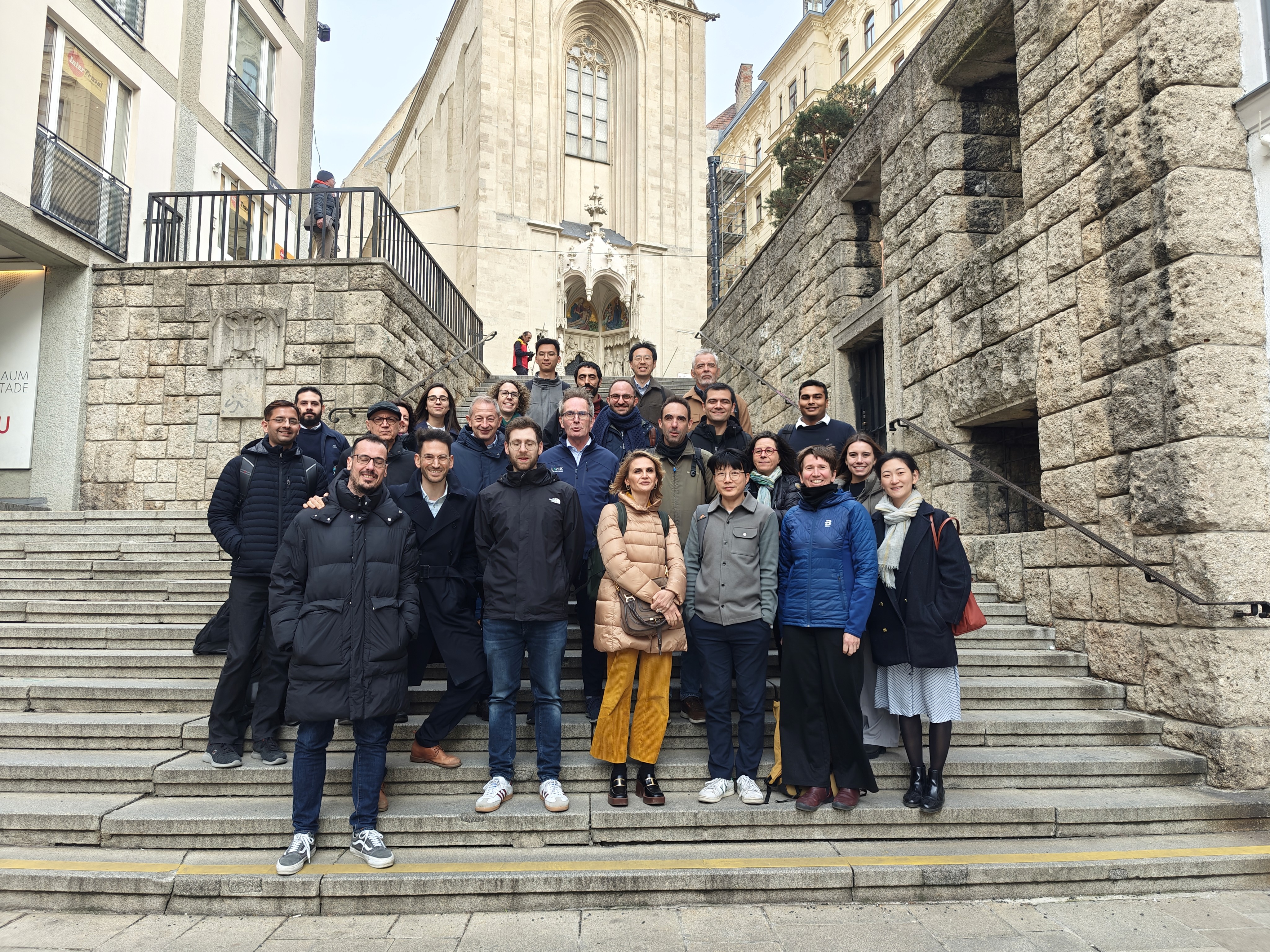
Gruppenfoto von Teilnehmenden aus dem ersten Vorbereitungs-Workshop in Wien 2025
© Institute of Building Research and Innovation